

With the realities of what the ongoing trade escalation could mean for the world starting to set in, markets are crashing across the world. Asian markets have crashed on their opens on April 7th, with many stock exchanges hitting circuit breakers. Sri Lanka has seen the same as well.
While there is some possibility that the current tariff regimes could reverse to some extent with negotiations, we’re of the view that fundamentally the world is in a higher tariff regime. The big risk for us here, is that this is a scenario of global recession. Such a global recession is likely to be far more impactful on global assets than tariffs on individual countries alone. We think the recent fall in global assets, and especially in oil, which has crashed 15% since April 2nd, is reflecting increasing market worries of such a scenario.
In such a context, preparing for the tail risk scenario of a global crisis becomes critical. For an investor, what would that look like?
This note is under the “Trader’s Edge” product line by Frontier, which is aimed at providing perspective to those interested in short-term trading opportunities in financial markets. The full note sent to clients includes a more detailed and applied exploration of these questions. A few limited extracts of these are given below in the context of the global environment -
What would a global crisis look like in the current environment?
In our recent report “Frontier Global Watch | The Global Economy in Transition”, we spoke about how there are varied ways we see the global economy moving from this point onwards. We gave 4 main scenarios –
1 - Both US deficits and Chinese surpluses shrink
2 - Both US deficits and Chinese surpluses stay the same
3 - US deficits shrink, but Chinese surpluses stay strong
4 - US deficits stay strong, but Chinese surpluses shrink
These are big fundamental shifts we talked about, and whatever way the global economy goes, such shifts will be groundbreaking in the short-term. While we have more details on how we think about the economy in our detailed report linked above, we think the investment impacts of a full-blown “global crisis” can be summarized into two scenarios.
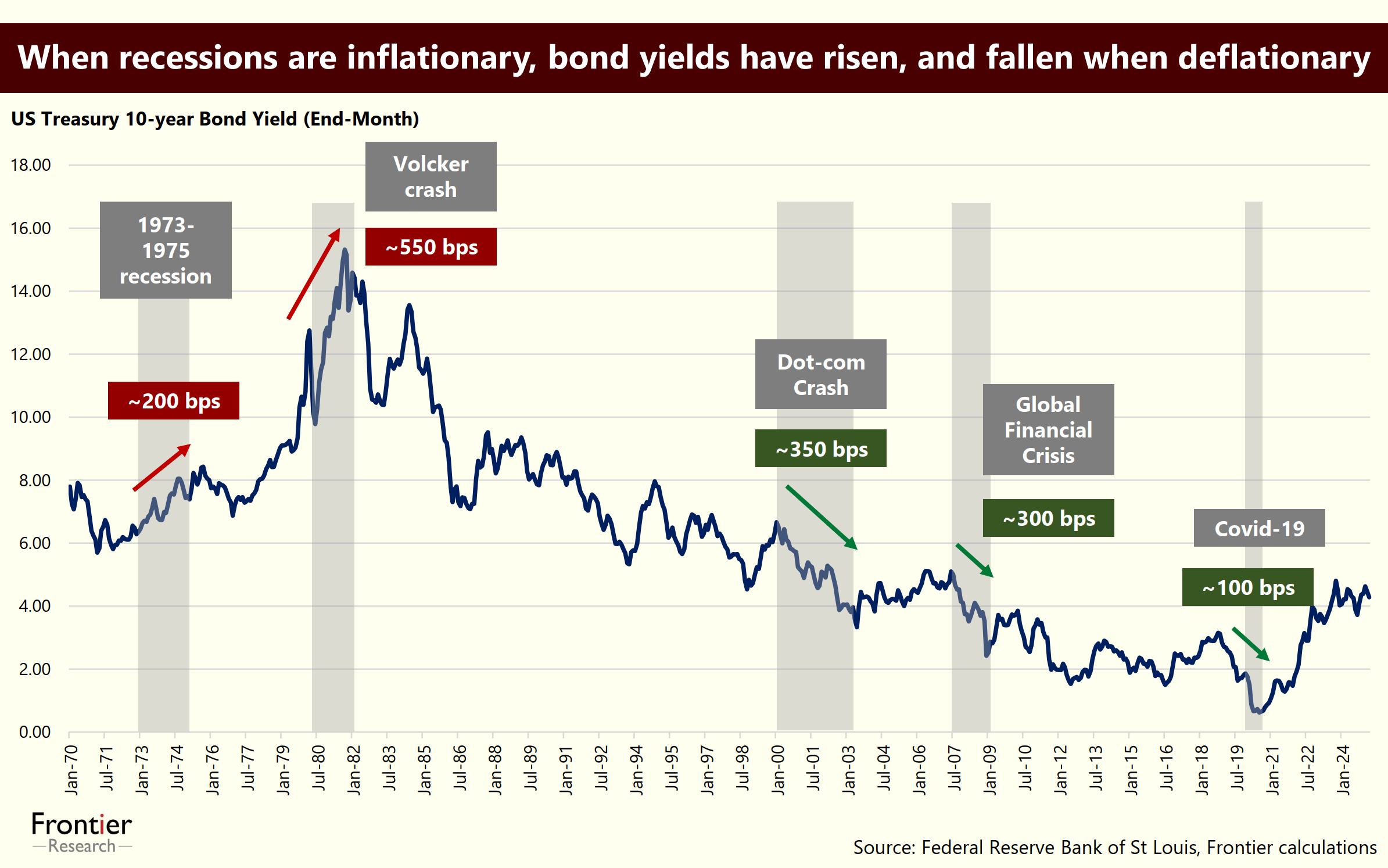
1 - Deflationary recession – Where global demand falls, commodity prices fall, and the world sees a period of low prices alongside recession
2 - Inflationary recession – Where global demand falls, but a sharp contraction in global production and supply alongside direct tariff impacts push prices higher across the world.
What should an investor do for a deflationary recession?
If the world is to see a deflationary recession, then the immediate consequences will likely be a contraction of global equities, global commodities, and falling inflation. Recent episodes of similar nature have been met with strong and coordinated global action by central banks. Interest rates have been lowered, liquidity has flooded markets, and asset prices have eventually roared up after a crash.
What should an investor do for an inflationary recession?
If the world is to see an inflationary recession, then the immediate consequences are likely to include a fall in global equities, but where global commodities and prices shoot up. The most recent global context where a similar was seen was in the 1970s, where global central banks ended up hiking rates instead to deal with inflation. Even stretching back a hundred years, such contexts have meant falling equity returns, falling fixed income returns, and commodities in particular massively overperforming.
What should an investor do if they don’t know what’s going to happen?
In reality, whether the world sees a deflationary recession, an inflationary recession, or no recession at all is not something visible right now. It seems inaccurate to claim that the world is “certain” at this point in time. Most of the prior “patterns” in the world have shifted drastically, and the way the future is moving is more uncertain than at many points in the past.
What if we tie this to Sri Lanka specifically?
For an investor in the Sri Lankan economy, they’re also dealing with the changing Sri Lankan context right at the same time the global economy changes. While the Sri Lankan BOP is a big one that everyone is keeping an eye on, one particular thing we’re looking out for is whether Sri Lanka’s fiscal recovery slows down.
Given the uncertainties present, we will leave with our usual mantra when considering an uncertain situation. While we can’t predict the future, when things move fast, we can move to prepare for it.
“You can’t predict. You can prepare”
- Howard Marks
Frontier usually restricts sharing of their research and advisory notes. In exceptional situations, such as the currently volatile global environment, we are open to limited sharing of our work. We just ask that you inform us ahead of time of such a limited sharing.
For limited time access to the full note, please reach out to us on research@frontiergroup.info. Clients who have access to Frontier Athena can visit athena.frontiergroup.info
(Frontier Research is a Colombo-based firm that engages in macroeconomic research and advisory for corporate and investment clients on Sri Lanka, South Asia, and South East Asia.)